
Foresight Workshop Focuses on Ukraine’s R&I Futures
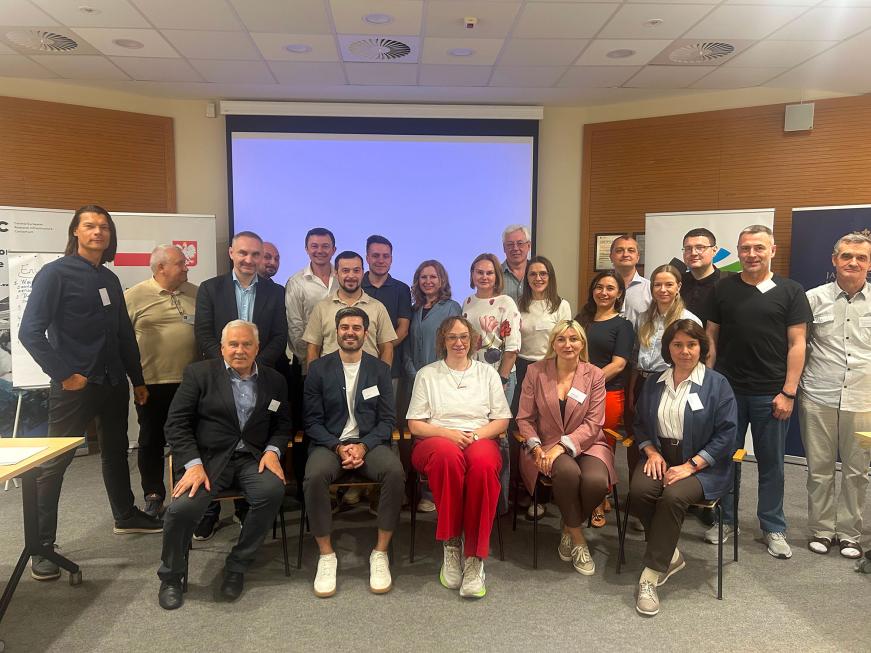
29th July 2026 — The Knowledge Hub of the European LUKE project aims to familiarise Ukrainian partners with strategic foresight, science diplomacy, cooperation between science and business, and research management. On 22 and 23 July 2026, DLR Projektträger, which coordinates both the project and the Hub, held an international Strategic Foresight Workshop at the SOLARIS National Syn-chrotron Radiation Centre in Kraków.
The event brought together 22 experts from Ukraine, including five members of the Ukrainian diaspora. Their goal was to develop strategic priorities for Ukraine’s research and innovation landscape up to 2035.
First, the groups explored the possible knock-on effects of key trends. On the second day, they translated the results of their analyses into strategic approaches. DLR Projektträger used the “Three Horizons” method, which maps the path from the present to a desired future scenario in three stages: the current system, ongoing transition initiatives, and the target research and innovation system for 2035. Participants worked in groups to assign their findings to these three stages.
Four Priorities for the Future of Ukrainian Research
The process identified four priority areas that outline what a future research and innovation agenda for Ukraine could include:
- Talent, workforce development, and continuity of knowledge
- AI and the changing nature of research work
- The international standing and governance of Ukrainian research
- Research funding, infrastructure, and the innovation economy
Across all four areas, brain drain emerged as a central current challenge. When researchers leave the country, the system loses teaching capacity, research depth, economic output, and continuity of knowledge at the same time. The situation is further exacerbated by the fact that EU integration is advancing faster than Ukraine can establish the national institutions needed for accession to the EU.

The reconstruction of Ukraine’s research system will not be decided only after the war, but by the choices being made now.
Strategic Foresight Methods for Reconstruction
The workshop in Kraków was part of the EU-funded LUKE project, through which DLR Pro-jektträger supports Ukraine’s scientific community in building a resilient, future-oriented re-search system. Strategic foresight plays a key role in this process. It enables stakeholders to look beyond immediate crisis management and makes potential goals for 2035 open to discussion before funding decisions and reforms effectively determine them.
This helps ensure that priorities are supported by Ukrainian stakeholders themselves rather than imposed from outside. One example is the rebuilding of internationally recognised re-search infrastructures in Ukraine, some of which could become leaders at European level. An-other future objective developed during the workshop is to fully harness the potential of sci-ence attachés at Ukrainian embassies.
LUKE brings Ukrainian and European research stakeholders together to jointly lay the founda-tions for a future-oriented research and innovation system.
The LUKE project is building a multilateral platform to support funding and capacity building in Ukraine. Funding organisations from twelve countries jointly finance transnational research and innovation projects involving Ukrainian partners and strengthen Ukraine’s integration into the European Research Area. The project is coordinated by DLR Projektträger.
 Linkedin
 Xing
Xing
 Facebook
 X
X